As 2025 comes to an end, Qarib concludes a full year of work alongside its partners in Jordan, Palestine, Iraq, and Lebanon, during which the total output supported by the program exceeded nearly 2,400 pieces across various forms of media production.
We begin a new year in which we will continue supporting our partners in these countries and, midway through the year—in June—we will celebrate colleagues who have worked on exceptional issues and topics through the Qarib Award, which we announced at the end of last year. Further details can be found later in this message.
In 2025, the production of our partners focused on a wide range of issues covered under the Qarib program, from women’s rights and issues affecting marginalized groups, to youth empowerment and matters connected to everyday life under war and crisis—of which there are many in these countries. The program also followed issues closely tied to public interests, including major political and media-related topics, through Qarib Talks, which hosted a group of experts, analysts, and journalists. Among these were discussions surrounding the Syrian debate that followed the fall of Bashar al-Assad, particularly on transitional justice, as well as the Iraqi elections in the autumn and their implications, alongside other topics that attracted significant attention and engagement. This was all in addition to ongoing concerns around media freedoms and the restrictions they face.
Our project also responded to partners’ needs in capacity building and strengthening their skills by organizing trainings based on their requests, aimed at empowering media teams working across several platforms in different areas. One of the most prominent initiatives launched under Qarib was the artificial intelligence program, implemented in strategic cooperation with the Financial Times. Through this program, our partners benefited from sessions on best practices in AI usage. The training will continue in the new year with a number of institutions individually, in response to each institution’s plan to further develop its use of artificial intelligence.
The stories and reports produced by our partners were followed by readers and audiences with growing interest, as the majority of partner platforms recorded expanded reach and higher engagement rates. Yet behind every story is a platform, and behind every platform lies effort, personal stories, and daily experiences that are often marked by hardship.
Qarib Magazine presents below some of these stories and personal reflections, so that together we may share what lies beyond the news.
Gaza on the Threshold of 2026
Fadi Al-Hasani – The Last Story
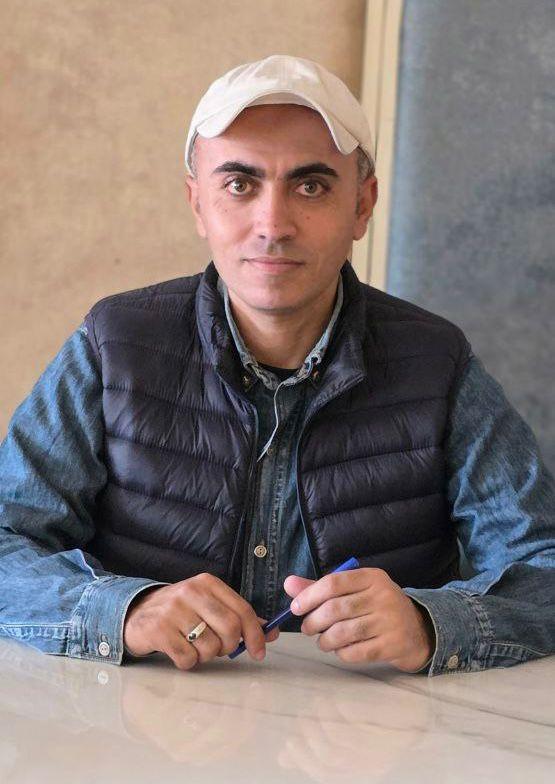
Another year has passed in the life of the war on the Gaza Strip, and with it another year in the lives of people living in the hope of survival. It has been a heavy year for Gaza’s residents, one in which nothing felt normal except death, destruction, and prolonged waiting—waiting whose end, or even shape, no one can define.
As Gaza enters 2026, it does so burdened with losses: tents that offer no protection from cold or bombardment, and cities that are no longer cities but gray expanses of rubble. People there are not waiting for big dreams; they are searching for the bare minimum of life: temporary safety, a loaf of bread, and a sip of clean water.
Every morning, a small hope is born with the sunrise, only to be tested by the first sound of an aircraft or a shell. Yet the people of Gaza continue to cling to life, rearranging their tents, repairing what can be repaired, and crafting from pain endless stories of resilience.
The year 2026 in Gaza is not a new beginning, but a continuation of the struggle for survival. It is also a year that carries within it a rare human determination—the determination that life, no matter how constrained, is still worth living.
2025 Was a Year of Existential Challenge
Tala Al-Sharif – Women of the Camera
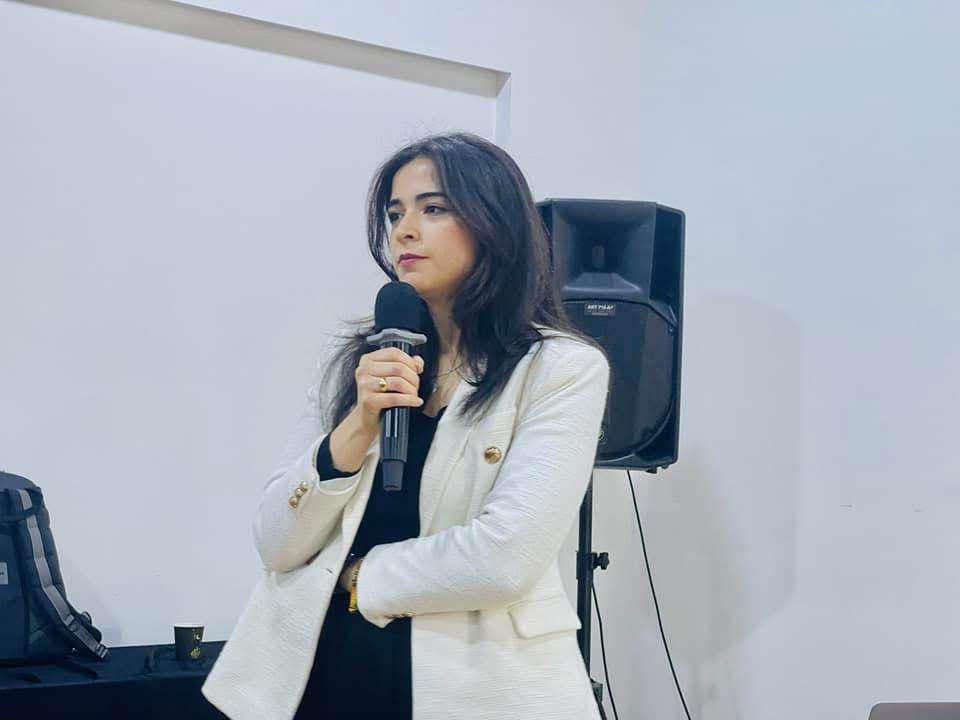
The year 2025 was not merely another stop in the trajectory of Palestinian journalism; it was a genuine existential test. A test of the ability to continue, and to convey the truth amid an unrelenting war and a constant danger that accompanies the camera and the journalist wherever they go.
For women behind the camera, the challenge was not only reaching the field, but remaining there and continuing to work under immense psychological pressure, personal losses, and endless daily fears.
Nevertheless, the experience proved that persistence in documentation is a form of resistance. Every photograph and every video clip is a testimony to a time that must not be forgotten, and to a reality that must be told as it is, without distortion or embellishment.
The year 2025 was harsh, but it reaffirmed that journalism is not merely a profession—it is an ethical and human commitment, especially when silence becomes a partner in crime.
The Struggle Between Professionalism and Humanity in Media Work
Monia Dweik – Ruyat Filastin
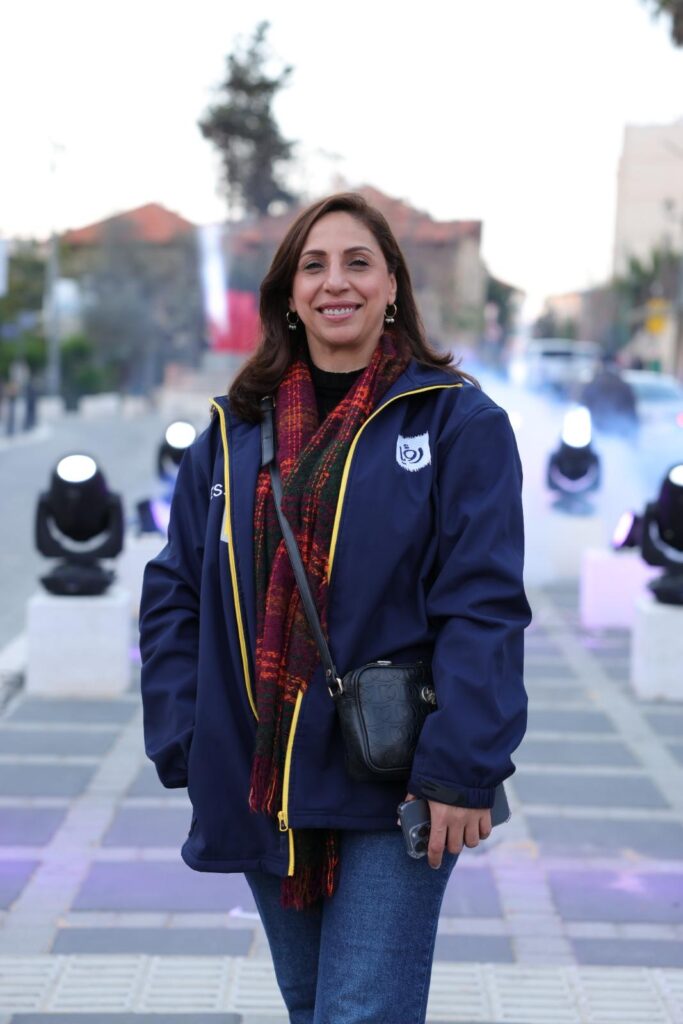
In the midst of war, journalism becomes a blurred space between what is professional and what is human. How can a journalist adhere to objectivity while documenting suffering that they themselves may be part of?
This question accompanied many Palestinian journalists throughout 2025, as traditional rules of media work were no longer sufficient to contain the magnitude of pain and loss. Emotions intertwine with the news, and humanity precedes the headline.
In this experience, confusion becomes part of daily life, yet commitment to conveying the truth remains the only compass—even when the psychological and human cost is high.
In Iraq: My Experience in Journalism
Haider Al-Saadi – Soh Agency
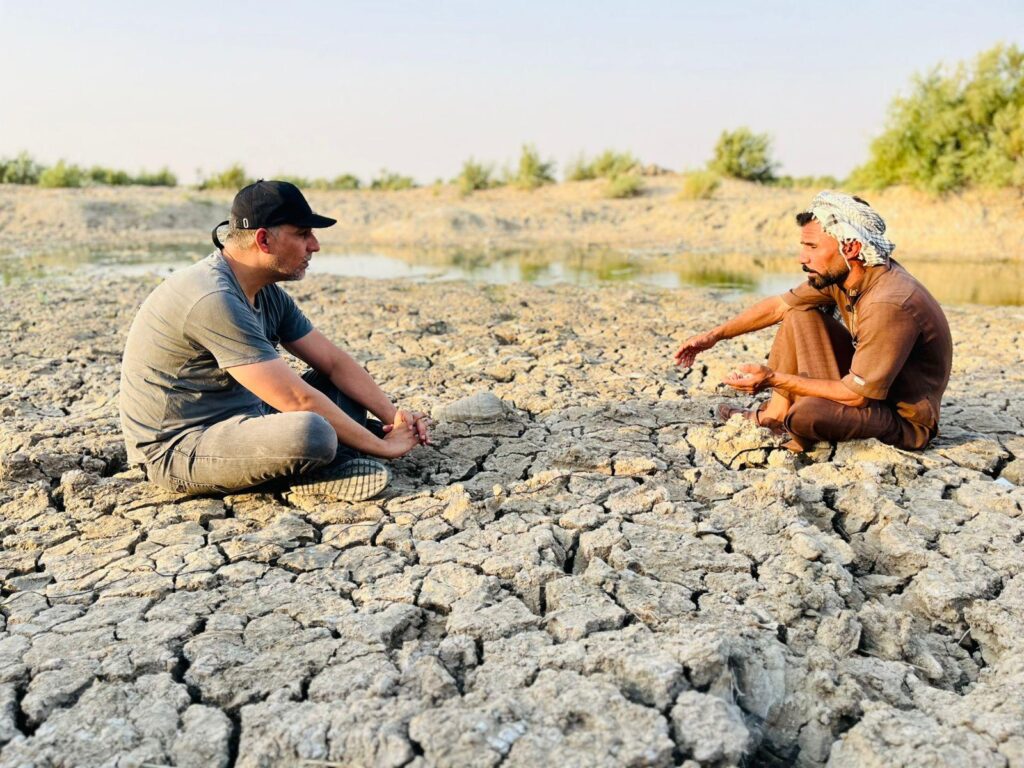
Journalistic work in Iraq is not an easy task; it requires a deep understanding of political and social balances, and a high level of sensitivity in dealing with complex issues where politics intersects with tribal structures and elections.
During 2025, Iraqi journalists faced increasing challenges, from political pressure to field risks, yet the need for independent media remained more urgent than ever.
This experience confirmed that journalism in Iraq is not merely about reporting news, but a responsibility that requires courage, patience, and long-term commitment.
Lebanon: A Country of Ongoing War and Widespread Corruption
Zuhair Debs – Manateq Net
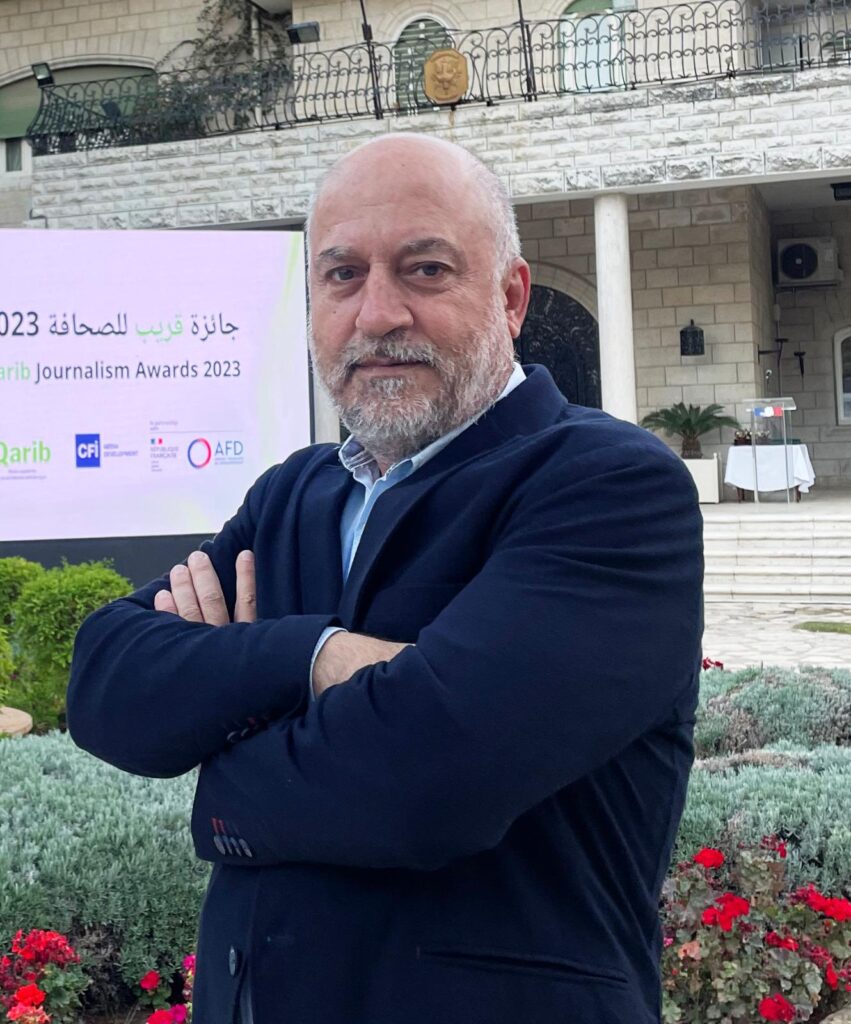
In Lebanon, crises accumulate without radical solutions—from economic collapse to widespread corruption, and intermittent wars that further erode the fragility of daily life.
Amid this landscape, independent media platforms continue their work despite limited resources and multiple pressures, striving to preserve space for free narratives and accountability.
Thanks to the support of the Qarib program, Manateq Net has been able to continue producing content that reflects people’s realities and gives them a voice amid the noise of politics and crises.
Al-Thalil Radio in Zarqa Governorate: A Voice for Women and Youth
Najwa Suleiman – Sawt Al-Thalil Radio
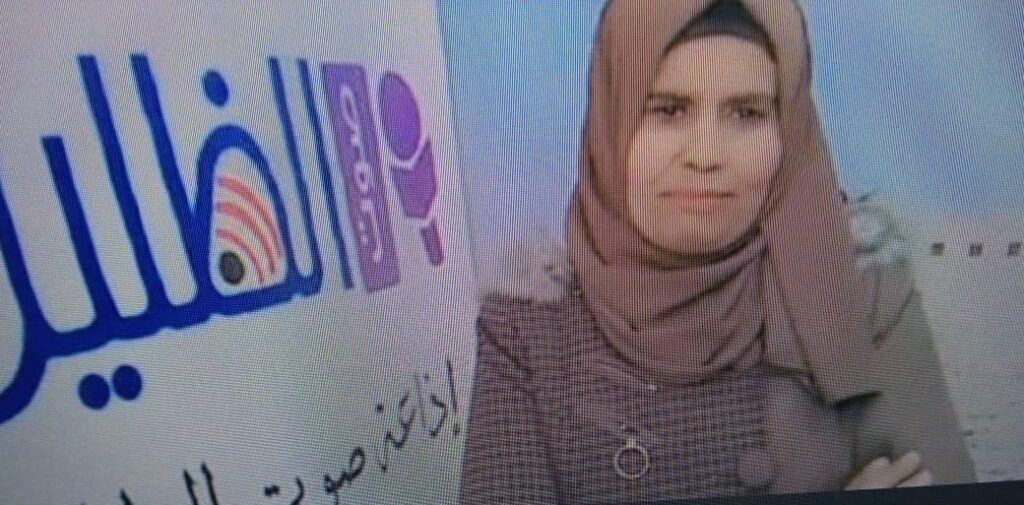
Al-Thalil Radio was initially launched with support from AmmanNet. I began working with Radio Al-Balad and AmmanNet through the newspaper Hona Al-Zarqa. I was among the journalists who received training and prepared audio and written reports, as well as program episodes for the newspaper. This work was part of a radio program aimed at addressing various issues related to Zarqa Governorate.
Later, the idea emerged to establish a media initiative dedicated to serving issues in Al-Thalil area of Zarqa. Through Al-Atayat Association, we moved toward producing media materials that reflect issues related to youth, women, the environment, and marginalized groups. We launched awareness programs, talk shows, reports, and stories, conveying the voice of the community and citizens and expressing their views.
Today, the radio focuses on issues related to agriculture, education, the environment, women’s rights, unemployment, youth empowerment, and the rights of children and persons with disabilities. It also highlights the achievements and successes of Jordanian women, their leadership roles, creativity, and talents, while strengthening the role of civil society organizations in community development. The station broadcasts its programs via Facebook and its website, and has achieved significant success in reaching thousands of followers and generating high levels of audience participation and engagement.
Qarib Activities
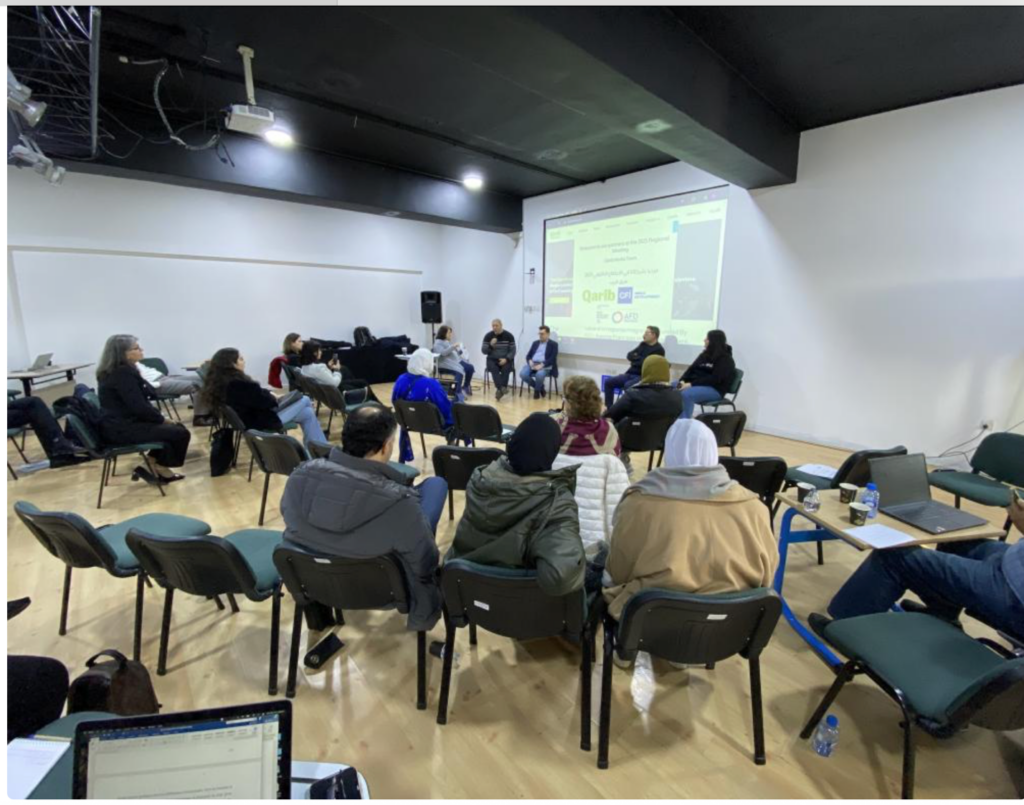
Among our most notable activities over the past year were meetings with our partners in Lebanon, Iraq, Jordan, and Palestine, during which we discussed the challenges facing media—particularly in light of restrictions on press freedom in several countries and amendments to media laws that have raised concerns about increased repression.
Additionally, we organized a regional meeting in Amman after repeated postponements due to the war on Gaza and Lebanon and the accompanying regional tensions, particularly in Iraq. The meeting addressed the challenges faced by media platforms and their plans to ensure continuity and sustainability amid declining donor funding as a result of:
first, the U.S. decision to halt funding for overseas development agencies; and second, the crises affecting European countries, which have led to the rise of right-wing governments in some states and increased defense spending at the expense of other funding, particularly support for alternative media.
Environment and the Qarib Exhibition
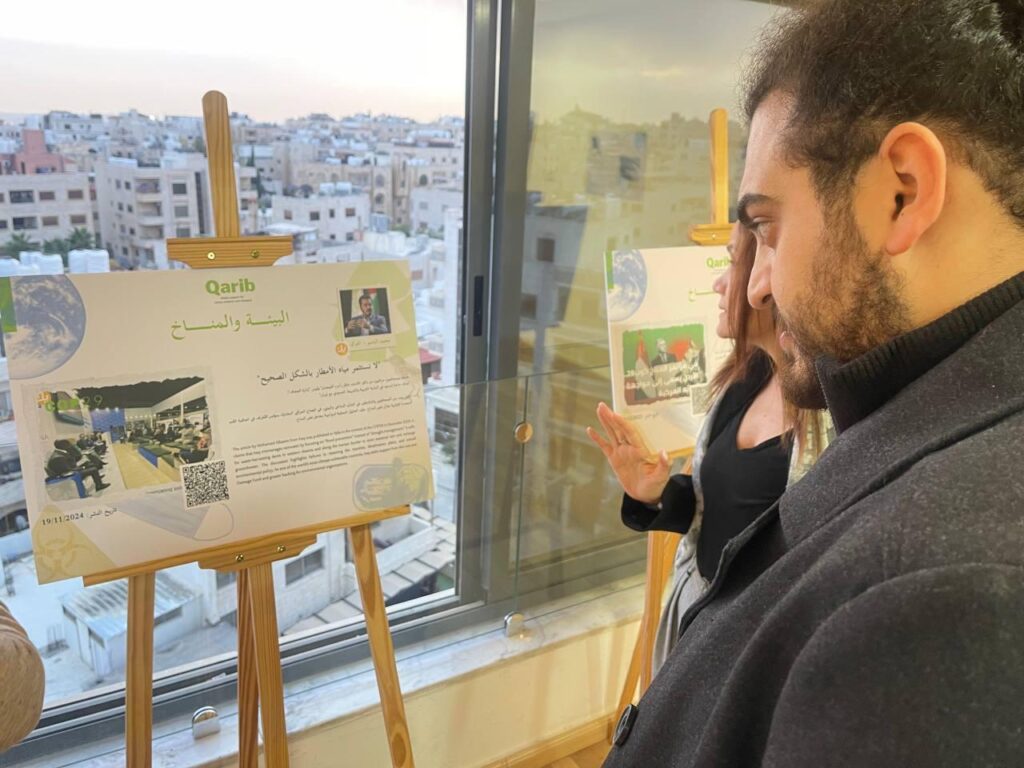
Environmental issues and related challenges occupied a significant space within the program’s priorities and follow-ups. We organized an exhibition at the Qarib office in Amman showcasing productions supported by the program, whether from the most recent COP conference or the previous year, when the program covered travel costs for a number of journalists to provide on-site coverage.
It is worth noting that through colleague Susan Baqlaini, the Qarib program supported a group of journalists who chose to cover environmental and climate-related issues relevant to their countries. The COP conference is an annual meeting of countries that are signatories to the United Nations Framework Convention on Climate Change.
Qarib Talks
Environmental issues and related challenges continued to occupy a significant space within the program’s focus. We organized an exhibition at the Qarib office in Amman showcasing program-supported productions from recent and previous COP conferences, during which the program covered travel costs for journalists to report directly from the conference venue.
Through colleague Susan Baqlaini, Qarib supported a group of journalists covering environmental and climate issues relevant to their countries. COP is the annual meeting of countries party to the United Nations Framework Convention on Climate Change.
Qarib Award
The Qarib program announced the 2025 Journalism Award, which aims to honor journalists and independent media institutions in Jordan, Palestine, Iraq, and Lebanon, in recognition of their efforts to produce professional media content addressing impactful public issues.
The award comes as part of supporting independent journalism and strengthening its role in serving local communities, particularly in light of the political, economic, and security challenges facing the region.
Award Categories
- Best Coverage of Climate Issues
- Best Coverage of Women’s Rights
- Best Investigative Report
- Best Coverage of Youth Issues
The value of the award is USD 2,000 per category.
Applications can be submitted via the following link.
Qarib Community
Throughout 2025, the Qarib program continued building a supportive community for journalists by organizing participatory sessions, trainings, and open discussions addressing the professional and psychological challenges faced by media workers.
The program also worked to strengthen communication among partners and encourage the exchange of experiences and expertise, contributing to the development of independent journalism in the region.
For more information about the Qarib program and its activities, please visit the website:
As 2026 begins, the Qarib program remains committed to supporting independent journalism and standing alongside journalists in the region, in the belief that free media is a fundamental pillar of any society striving for justice and transparency.